Why a gas tankless heater needs power
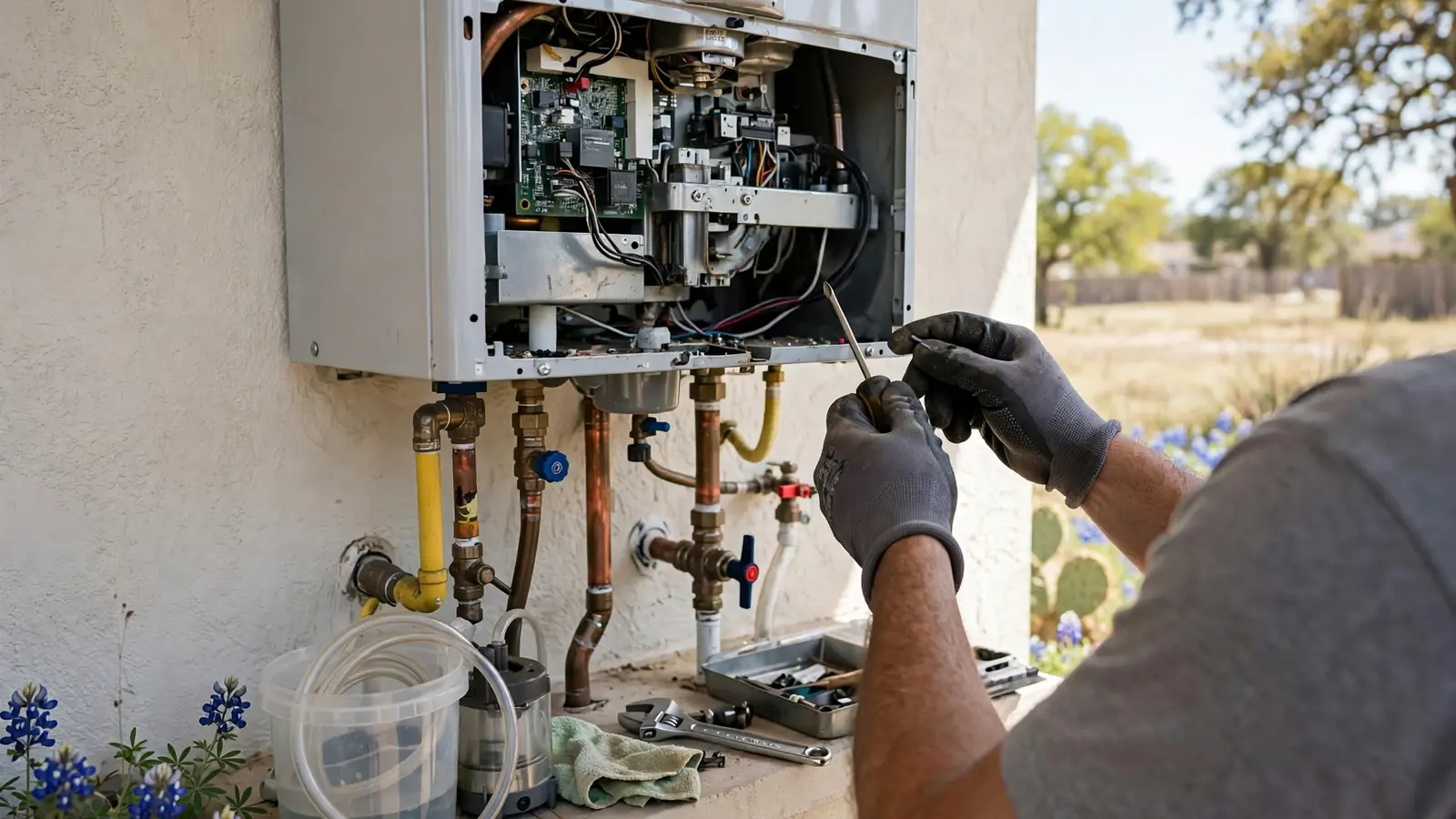
A gas tankless unit burns gas, but it also runs a circuit board, a flow sensor, an exhaust fan, and an igniter. All of that runs on household electricity. When power drops, the sensors and fan stop, and the unit shuts down for safety.
A traditional tank heater with a standing pilot is different. It can keep heating through an outage because it does not need power to light. That contrast surprises many homeowners who switch to tankless.
Electric tankless units are a different story
An electric tankless heater draws a very large amount of current while it heats water. That is more than a typical battery backup can supply. For these units, a battery is not a practical plan, and a whole-house generator is the usual option for outages.
If your home has an electric unit, plan around the outage instead of trying to power the heater. Hot water stored in a tank elsewhere, or a small plan for the time without power, is more realistic.
Questions to answer before you buy a backup
Details on your own unit decide what works.
- Check the data plate on the heater for its electrical rating, which tells you what the controls and fan draw.
- Confirm whether your unit is gas or electric, since the answer changes the plan completely.
- Decide how long an outage you want to cover, since runtime depends on battery size.
- Ask the manufacturer or installer whether a battery or inverter backup is compatible with your model.
- Plan where the backup will sit, since batteries need ventilation and protection from heat.
Backup options compared
Each option fits a different need.
| Option | Works with | Watch for |
|---|---|---|
| Battery backup or UPS | Gas units with low electrical draw | Runtime is limited, and the unit must be compatible |
| Inverter with a battery bank | Gas units, longer runtime | Needs proper sizing and installation |
| Portable generator | Gas units, short-term use | Never run it indoors or in a garage |
| Whole-house generator | Gas and electric units | Larger investment, needs a transfer switch |
Sizing the backup without guessing
The right battery depends on how much power the heater uses and how long you want it to run. Gas tankless units usually draw far less than an electric element, but the exact number is on the data plate or in the manual. We do not guess it from memory, and you should not either.
A plumber or electrician can read the label, add up the load, and size a backup so it does not shut down at the wrong moment. If the manual forbids an add-on power source, follow the manual.
Safety rules that matter more than convenience
Never run a generator in a garage, a basement, or near a window. Exhaust from a generator contains carbon monoxide, which can cause serious harm. Keep it outside, away from openings, and put a battery-powered carbon monoxide alarm in the home.
If you ever smell gas, which is often described as rotten eggs, leave the building. Call 911 and your gas utility from outside. For natural gas in this area, that utility is Southwest Gas. Do not try to relight or reset the heater.
Storm season and outages in Sahuarita
The Green Valley area has a hot, humid monsoon season from July through September, according to climate summaries of the area. Thunderstorms in that window can interrupt power, and an outage in summer heat makes cold showers less of a hardship than a failed air conditioner.
That is a reason to plan for the whole house, not only the heater. A small backup for a tankless unit helps with hot water, but your plan for cooling and food storage matters more.
Is tankless still the right choice?
Tankless heaters have real advantages, including endless hot water, a smaller footprint, and lower standby loss. The outage question is one trade-off among several. Our page on tankless water heaters explains the others, including venting and gas line size.
If outages worry you, a tank unit keeps hot water in the tank for a while even without power. You can also ask about a hybrid plan. Our team can explain the trade-offs on the water heater installation page or by phone.
Installation details that affect backup power
Where the heater plugs in matters. A unit on a dedicated outlet with a surge protector is easier to connect to a backup than one hardwired into a shared circuit. Ask your installer how the unit is powered and where the backup could tie in.
Also think about the rest of the system. A recirculation pump, a condensate neutralizer, or a smart controller adds to the load, and each one needs power too. List every powered part before you size a battery, or the runtime will fall short.
What happens when the power comes back
Most units restart on their own, but some show an error code after a sudden power loss. Check the display and your manual before you assume something broke. A reset is often all it takes.
Power surges can follow an outage and damage the control board. A surge protector at the outlet is a low-cost safeguard. If the unit will not restart after a reset, a plumber can check the board, the flow sensor, and the vent.
What the manual and the guidelines say
A gas tankless unit is listed by a testing laboratory, and the manufacturer's instructions govern what power sources are allowed. Adding a battery or inverter that the manual does not approve can void the warranty.
Generators have their own safety guidelines, including keeping them outdoors and away from openings.
Tankless backup power questions in Sahuarita
Will my tankless heater work if the power goes out?
Usually not. Even gas units need electricity for controls, the fan, and ignition.
Can I run a tankless heater on a portable generator?
Some gas units can, if the generator is sized correctly and kept outdoors. Check your manual first.
Can a battery run an electric tankless heater?
Not in practice. Electric units draw too much current for a typical battery backup.
Where do I find how much power my unit uses?
Look at the data plate on the heater or the installation manual.
Does Sahuarita have frequent outages?
We do not have outage statistics. Storm season runs from July through September, so planning ahead is sensible.
Do you install tankless heaters in Green Valley?
Yes. See the Green Valley page.